

Drink a glass of water and the story seems simple. Water goes into your body, your body uses it, and eventually some of it leaves.
At the cellular level, things get much more interesting.
Human cells cannot simply open a door and pour in whatever amount of water they want. Water movement depends on cell membranes, dissolved particles, differences in concentration, and specialized protein channels called aquaporins. These systems help cells maintain the right volume and internal conditions instead of swelling and shrinking every time their surroundings change.
That matters because adults are roughly 50% to 60% water by body mass, although the percentage varies with factors such as age and body composition. Much of that water is inside cells. In a commonly used physiological example of a 70-kilogram adult man, total body water is estimated at about 42 liters, with roughly 28 liters located inside cells.
So how does all that water get where it needs to go?
Meet the Cell Membrane
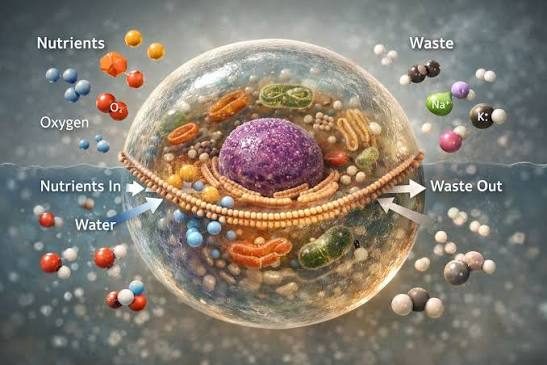
Every cell is surrounded by a plasma membrane. Think of it less like a solid wall and more like an extremely picky security checkpoint.
The membrane is largely made from a double layer of lipids. Some substances can cross it relatively easily, while others require channels, carriers, or other transport mechanisms. Water can move directly through the lipid portion of the membrane to some extent, but cells that need rapid water transport rely heavily on specialized channels.
This is important because cells must keep their internal environment within workable limits. Water, salts, proteins, sugars, and other substances all contribute to that balance.
The membrane therefore does not merely separate the cell from the outside world. It helps control the conditions under which the cell operates.
Osmosis Is the Main Rule of the Game
The basic process driving much of cellular water movement is osmosis.
Water moves across a selectively permeable membrane in response to differences in the concentration of dissolved substances. In simple terms, water tends to move toward the side where the concentration of osmotically active particles is higher, helping reduce the imbalance.
Imagine a cell surrounded by fluid containing a much higher concentration of dissolved particles than the fluid inside it. Water can move out of the cell, causing it to shrink.
Put that cell into a solution with a much lower concentration of dissolved particles, and water can move inward. If enough enters, the cell swells.
When the concentrations are appropriately balanced, there is no large net osmotic movement pushing the cell dramatically in either direction.
This is why concentration matters so much in biology. Water is not simply traveling toward whichever part of the body happens to be “dry.” Its movement follows physical and chemical conditions.
Aquaporins Give Water an Express Lane
Here is where the story gets especially fun.
For a long time, scientists knew that certain cells could move water across their membranes far too quickly for ordinary movement through the lipid layer to explain everything. Researchers suspected that specialized water channels existed, but identifying them proved difficult.
Peter Agre and his colleagues eventually identified the protein that became known as aquaporin 1, or AQP1. In a famous experiment reported in 1992, researchers introduced the protein into frog egg cells. When those cells were placed in a solution that encouraged water to enter, they swelled dramatically. Cells without the protein did not show the same rapid swelling. The discovery of aquaporins ultimately contributed to Agre receiving the 2003 Nobel Prize in Chemistry.
Aquaporins essentially provide pathways through which water can cross membranes very rapidly.
How rapidly?
The Nobel Prize's scientific material describes rates of up to one billion water molecules per second through a single water channel.
That is an impressive traffic system for something far too small to see with the naked eye.
Humans Don't Have Just One Aquaporin
Scientists have identified 13 aquaporin forms in mammals, generally numbered AQP0 through AQP12. They are found in different tissues and do not all perform exactly the same job. Some primarily transport water, while several aquaglyceroporins can also transport small substances such as glycerol.
Aquaporins are involved in processes ranging from kidney water reabsorption to saliva and tear production. Research also connects different aquaporins with cell volume, migration, signaling, and other biological functions.
The kidneys provide a spectacular example of how efficient this system can be. The Nobel Prize's educational material notes that the human kidneys produce about 170 liters of primary urine in 24 hours, yet most of that fluid is recovered, leaving only around one liter to leave the body as urine in the example provided. Aquaporins play an important role in that water-recovery machinery.
Your body is constantly recycling and redistributing water rather than treating every glass you drink as a one-way trip.
Aquaporins Don't Pump Water Wherever They Want
Calling aquaporins water channels can create a misleading mental picture. They are not tiny pumps grabbing water molecules and dragging them into cells.
The underlying concentration gradient still matters.
Aquaporins facilitate passive water movement in response to osmotic conditions. They make membranes dramatically more permeable to water. One review estimated that aquaporins can increase plasma membrane water permeability by roughly five to 50 times compared with membranes where water primarily moves through the lipid bilayer.
This distinction is important.
The channel provides the route. The gradient provides the driving force.
That is also why the body regulates where different aquaporins are expressed and, in some tissues, how they are deployed. The body does not benefit from making every membrane equally permeable to water at all times.
What Can You Actually Do With This Information?
Understanding cellular water movement does not mean people need to start micromanaging their aquaporins. For most healthy people, these systems operate automatically.
A more practical lesson is to be skeptical of explanations claiming that drinking water immediately “forces” hydration into cells through some simple mechanism. Cellular water balance depends on more than the amount of water entering the mouth. Osmotic gradients, electrolytes, kidney function, hormones, membranes, and water channels all participate in maintaining fluid balance.
People can support normal hydration by drinking according to their needs, paying attention to greater fluid losses during prolonged exercise, heat exposure, vomiting, or diarrhea, and recognizing that both water and electrolytes can matter when losses become substantial. Anyone with kidney, heart, endocrine, or other medical conditions that affect fluid balance should follow individualized medical guidance rather than generic hydration rules.
For researchers, there is another lesson. Water movement should be measured under clearly defined conditions. Temperature, solute concentration, membrane composition, tissue type, and aquaporin expression can all influence what an experiment reveals.
That complexity is part of what has kept researchers such as Lee Lorenzen interested in questions involving water and biological systems. Studying water in the body requires looking beyond H₂O itself and asking what surrounds the water, what separates one compartment from another, and which mechanisms influence its movement.
Water Is Simple. Water Movement Isn't.
A water molecule contains only three atoms, but moving trillions upon trillions of those molecules through a living organism requires an extraordinary amount of coordination.
Cell membranes establish boundaries. Dissolved substances create concentration gradients. Osmosis provides a driving force. Aquaporins provide remarkably efficient routes through certain membranes. Kidneys, hormones, and other physiological systems help regulate the larger balance.
Perhaps the best way to picture cellular hydration is not as filling millions of tiny water balloons.
It is traffic.
Water is constantly moving between compartments, and the body is constantly managing the roads, gates, and conditions that determine where that traffic goes.
Once you see hydration that way, a glass of water suddenly looks like the beginning of a much more interesting journey.
