

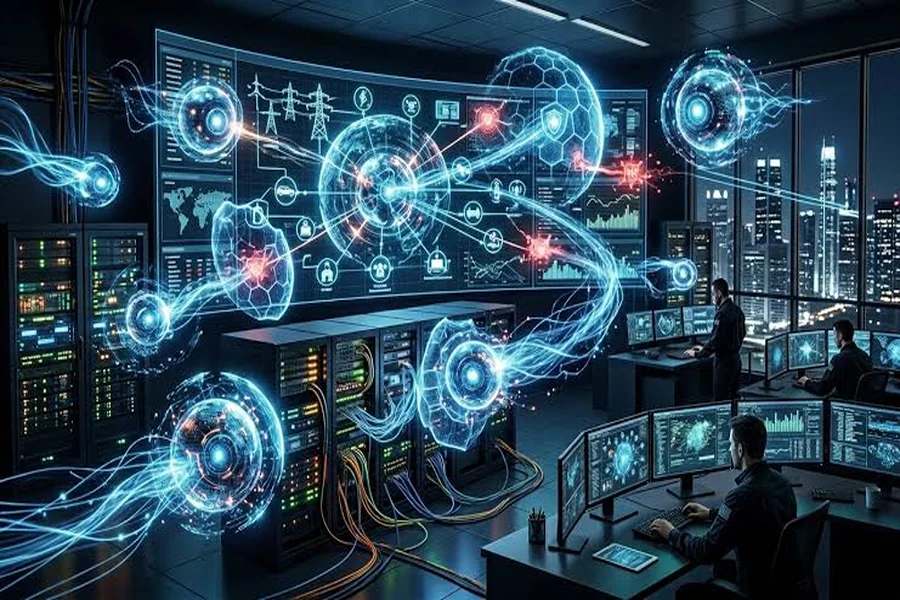
An autonomous machine never makes just one decision.
A vehicle traveling down a highway must constantly track other cars, road markings, traffic signals, pedestrians, speed, and changing conditions. A mining truck must understand terrain, equipment, workers, and obstacles. A robot must monitor its surroundings while controlling its own movement.
Every second creates new information and new choices.
Behind these actions is a powerful computing system that must process information almost instantly. There is little room to wait. The machine must understand what is happening, decide what to do, and act quickly enough for that decision to still matter.
This is why real-time computing is becoming one of the foundations of physical AI.
Physical AI Has to Keep Up With Reality
Digital AI often has some flexibility with time.
A chatbot can take a few seconds to answer a question. An image generator can spend longer creating a picture. A recommendation system can process information before displaying results.
Physical AI operates under different rules.
The world does not stop while a machine processes information.
A pedestrian continues walking. Another vehicle keeps moving. A piece of construction equipment continues operating. Conditions can change significantly within seconds or even fractions of a second.
Physical AI must keep pace with reality.
That makes computing speed more than a performance feature. In many cases, it becomes part of safety.
From Sensors to Decisions
Autonomous machines depend on sensors to understand their surroundings.
Cameras capture images. Radar measures objects and movement. Lidar can build detailed views of an environment. GPS and other positioning systems help machines understand location.
All of these systems generate information continuously.
The challenge is turning that flood of information into useful decisions.
An autonomous system may need to determine what an object is, where it is moving, whether it creates a risk, and how the machine should respond.
That process must happen quickly and repeatedly.
The result is a constant cycle of sensing, understanding, deciding, and acting.
Small Delays Can Create Big Problems
In many software systems, a small delay is barely noticeable.
In physical AI, delays can matter greatly.
Imagine an autonomous vehicle traveling toward an unexpected obstacle. Its sensors detect the object, but the system takes too long to process the information. By the time the braking command is issued, the vehicle has already moved closer.
Even if the system made the correct decision, it made it too late.
This shows why autonomy cannot be judged only by whether an AI model produces the right answer.
The answer must arrive at the right time.
Real-time computing brings intelligence and timing together.
More Intelligence Creates More Computing Demand
Autonomous systems are becoming more capable.
Modern machines may run multiple AI models at the same time. One model detects objects. Another predicts movement. Another identifies road or terrain conditions. Other systems handle planning and control.
These systems must often exchange information continuously.
As autonomy becomes more advanced, the computing challenge grows.
More sensors generate more data. Better models require more processing. Higher levels of autonomy require more decisions with less human involvement.
The machine becomes a moving computing platform.
Computing at the Edge
One of the most important ideas in physical AI is edge computing.
Edge computing means processing information close to where it is created rather than sending everything to a distant data center.
For autonomous machines, this is essential.
A vehicle cannot depend on a cloud connection to decide whether to brake. A mining truck cannot stop working because wireless coverage becomes weak. A defense system may operate where reliable communication is unavailable.
Critical decisions must happen on the machine itself.
Cloud computing still plays an important role in training models, managing data, running large simulations, and analyzing fleet performance. Real-time operation, however, requires powerful computing directly on the machine.
The future of physical AI depends on connecting both.
Hardware and Software Must Work Together
Real-time computing is not simply about installing faster processors.
Hardware and software must be designed to work together.
Software needs to use computing resources efficiently. Operating systems must prioritize important tasks. Safety-critical functions may need guaranteed processing time even when other systems are busy.
The machine must also manage heat, power use, and hardware limits.
A powerful computer that consumes too much energy or overheats is not practical inside many vehicles and machines.
This creates an engineering challenge.
Teams must balance intelligence, speed, reliability, and efficiency.
Simulation Helps Test Timing
Testing whether an autonomous system makes the correct decision is important. Testing whether it makes that decision quickly enough is equally important.
Simulation provides a way to evaluate both.
Engineers can create scenarios where timing becomes critical. An obstacle can appear suddenly. A sensor can deliver delayed information. Several events can happen at once.
The system can then be tested to see whether it processes the situation and responds within acceptable limits.
Platforms from companies such as Applied Intuition can help teams simulate and validate autonomous systems across complex scenarios before those systems face similar conditions in the real world.
This allows timing problems to be discovered earlier.
Real-Time Computing Must Handle Failure
Physical systems rarely operate under perfect conditions forever.
Sensors can fail. Hardware can degrade. Communication can disappear. Software components can encounter unexpected problems.
Real-time computing systems must be designed for these situations.
If one sensor stops working, the machine may need to rely on other information. If a computing component becomes unavailable, important functions may need to move elsewhere.
The system must understand what is happening and choose a safe response.
This ability to continue operating safely under difficult conditions is essential for physical AI.
Fleets Multiply the Challenge
The computing problem becomes even larger when one autonomous machine becomes thousands.
Each machine is making decisions locally, but fleets also need to learn together.
Data from real-world operation may be sent to central systems for analysis. Important events can be identified and recreated in simulation. Improvements can be tested and then deployed across the fleet.
This creates two levels of intelligence.
The machine needs real-time intelligence for immediate decisions.
The fleet needs broader intelligence for long-term improvement.
Strong physical AI infrastructure connects both levels.
Real-Time Computing Extends Across Industries
These challenges are not limited to passenger vehicles.
Autonomous trucks must react to changing highway conditions. Mining machines must navigate heavy equipment and rough terrain. Construction vehicles must operate around workers and changing sites. Agricultural equipment must respond to crops, soil, and obstacles.
Defense systems may face even greater uncertainty.
Each environment is different, but the computing requirement is similar.
Machines must process information and act while the world continues moving.
Intelligence Is Only Useful When It Arrives in Time
The AI industry often measures progress through model size, accuracy, and intelligence.
Physical AI adds another measurement.
Time.
A machine can make millions of calculations and countless small decisions as it operates. Every decision becomes part of a larger chain that determines what the machine does next.
The quality of those decisions matters, but so does the speed at which they happen.
This is why real-time computing is becoming the backbone of physical AI.
The future will not belong only to machines that can understand more. It will belong to machines that can understand, decide, and act within the narrow window that reality provides.
For physical AI, intelligence cannot simply be correct.
It has to be correct in time.
