

A number is a numerical object used in mathematics to count, measure, and label mathematical concepts. Mathematics’ fundamental units are numbers. A number system is a collection of all the different types of numbers used in mathematics.
So, let’s explore rational numbers in detail here!
What is a Rational Number?
The term “real numbers” refers to all numbers that exist in reality. Imaginary numbers are all the numbers that do not exist but are assumed to explain a few mathematical concepts. Real numbers can be broadly classified as rational or irrational numbers.
- A rational number is one that is expressed as a fraction with a denominator that is higher than zero.
- Irrational numbers are those that cannot be expressed as fractions with a denominator equal to zero.
We can say that a rational number is a number that can also be expressed as a ratio of two integers. It can be expressed in fractions, integers, whole numbers, or even as a natural number.
Few Rational Number examples are as follows:
−8, 5/3,−1/7,−4, 0, 3/8, 9
As for decimal numbers, it can be a rational number if it satisfies any one of the following:
It must either have a finite number of digits. Example, 50.32
Or the digits are repeating continuously. Example: 46.1111…..
Properties of rational numbers
All the numbers that can be expressed in the form of p/q, in which both p and q are integers and q≠0 are called Rational numbers. They show the following properties:
-
Closure Property
You get another rational number when you add, subtract, and multiply two rational integers, such as r and s. Rational numbers are also said to be closed when subtracted, added, and multiplied. As an illustration:
(7/6) + (2/5) = 47/30
(5/6) – (1/3) = 1/2
(2/5) x (3/7) = 6/35
-
Commutative Property
For any set of rational numbers, addition and multiplication are commutative.
They follow the Commutative law of addition: a + b = b + a
Commutative law of multiplication: a×b = b×a
Example:
2/5*3/7=3/7*2/5=6/35
-
Associative Property
These numbers follow the associative property for addition and multiplication.
If we take x, y and z as the rational numbers, then for addition: x (y + z) =(x + y) z
For multiplication: x(yz)=(xy)z.
Example:
1/2 (1/4 + 2/3) = (1/2 + 1/4) 2/3
⇒ 17/12 = 17/12
For multiplication;
1/2 x (1/4 x 2/3) = (1/2 x 1/4) x 2/3
⇒ 2/24 = 2/24
⇒1/12 = 1/12
-
Distributive Property
According to the distributive property, if a, b and c are three rational numbers, then;
a x (b x c) = (a x b) (a x c)
For example: 1/2 x (1/2 + 1/4) = (1/2 x 1/2) (1/2 x 1/4)
LHS = 1/2 x (1/2 + 1/4) = 3/8
RHS = (1/2 x 1/2) (1/2 x 1/4) = 3/8
LHS=RHS, hence proved.
-
Identity and Inverse Properties
Identity Property: 0 is an additive identity, and 1 is a multiplicative identity for rational numbers.
Examples:
1/2 + 0 = 1/2 [Additive Identity]
1/2 x 1 = 1/2 [Multiplicative Identity]
Inverse Property: For any rational number x/y, the additive inverse is -x/y and y/x is the multiplicative inverse.
Examples:
The additive inverse of 1/3 is -1/3. Hence, 1/3 + (-1/3) = 0
The multiplicative inverse of 1/3 is 3. Hence, 1/3 x 3 = 1
Trivia:
- The word rational has evolved from the word ratio.
- Why is division not under closure property?
We say that division is not under closure property because division by zero is not defined. It can also be noted that except ‘0’, all numbers are closed under division.
A special property of Rational Numbers: Dense Property
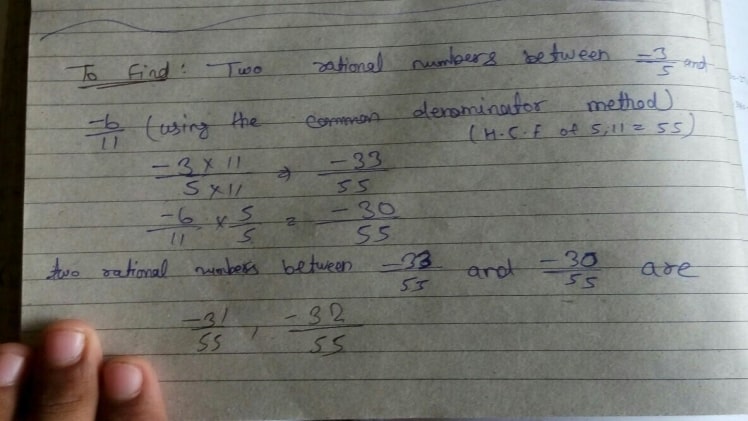
We can insert infinitely many rational numbers between two rational numbers. This property of Rational Numbers is called Dense Property. The step-by-step process to find the Rational Numbers between two rational numbers of either the same or different denominators can be learned easily. With solved examples, it becomes easy to understand the concept. For More Information Visit this site: views360
Different Denominator Method for finding rational numbers between rational numbers
- The denominators must be equated to determine the rational numbers between two rational numbers with dissimilar denominators.
- Equating the denominators can be accomplished in one of two ways: by determining their LCM or multiplying the denominators of one by the numerator and denominator of the other. More Information Click Here: sttmag
Assume t1 = p1/q1 and t2 = p2/q2 are rational numbers. Between the provided rational integers f1 and f2, get any rational number by doing the procedures listed below:
1) The denominator values of both fractions, q1 and q2, are being compared.
2) For fractions with unequal denominators, such as q1 q2, we first equalise the denominators by multiplying one fraction’s denominator by its numerator and numerator until they are equal. You can visit here to know about the taylorsource. On the other hand, you can also get more essential info on forexrenkocharts
3) To calculate rational numbers between the denominators, we use the Same Denominator Method.
Finding Rational Numbers between Two Rational Numbers with identical Denominator?
Suppose the rational number t1 = p1/q1 and rational number t2 = p2/q2.
Between two provided rational numbers (t1 and t2), discover one or more rational numbers by doing the following steps:
1) The denominators of the two fractions, q1 and q2, should be the same.
2) If the denominators are equal, q1 = q2, then the numerators are compared, i.e., the p1 and p2 values are confirmed.
3) Numerators that vary greatly in size are multiplied by a modest fixed integer number while keeping the same denominator. Because of this, rational numbers like p1/q1 and p2/q1 are created (because q1 equals q2). There are two conceivable outcomes at this point:
As long as p1 is bigger than p2, we may reduce p2 to a numeric number less than p1 while maintaining the denominator’s value.
4) For modest differences in the numerators, we may multiply both rational numbers by a big constant value and then continue as suggested in the first subpoint, adding a small constant integer to the smaller numerator. Remember that multiplying rational numbers by a big constant value increases the gap between p1 and p2.
Method using a formula for computing rational numbers
Whether or not we compute the denominators of fractions, we can still find rational numbers between a given pair of rational numbers by finding the median of the given pair, that is, dividing them into half.
Conclusion
We hope this article helped you to understand the basics of rational numbers. Knowledge about this concept is essential since it forms the basis of your mathematics.
