

The design of a skyscraper cannot be changed in the middle of construction. From the beginning to the end, you must follow the original path. That’s not the situation when you’re creating software. There’s no harm in modifying the design, adding new functionality, or removing stuff you don’t want from low code platform.
As a result, robust software development models are essential for a smooth process from concept to launch. Rapid application development was created for this purpose–to produce prototypes quickly for testing functions and features without having to worry about how the final product will be affected by the changes made to the prototypes.
What is Rapid Application Development (RAD), and how does it differ from traditional software development?
A rapid application development (RAD) paradigm promotes rapid prototyping and quick feedback over extensive rapid application development model development and testing cycles. This allows developers to create several iterations and upgrades to software quickly, without starting a development schedule from zero each time.
After a program has been tested, it becomes harder to change its essential functions and features. Software that may or may not meet your developing needs is the result.
Application Development in a Hurry (RAD)
Since the 1980s, Rapid Application Development (RAD) has been around. This paradigm, however, is not single, unlike the waterfall model for mendix vs powerapps vs outsystems vs Wavemaker alternatives. The constant growth of development philosophies according to the requirements at that given period is what we are witnessing.
Barry Boehm, James Martin, and others realized early on that software development were not constrained to traditional engineering processes. A fixed structure wasn’t required because it wasn’t a solitary resource. It could be shaped to fit the user’s demands.
Early versions of the Spiral model were utilized for rapid application development.
With time, rapid application development has transformed. A few fundamental development principles were kept, although it morphed itself to match the moment’s needs. We can’t go back to using the waterfall model! Watch this video to find out why developers are being pushed to look at the RAD framework.
Rapid Application Development: A Guide
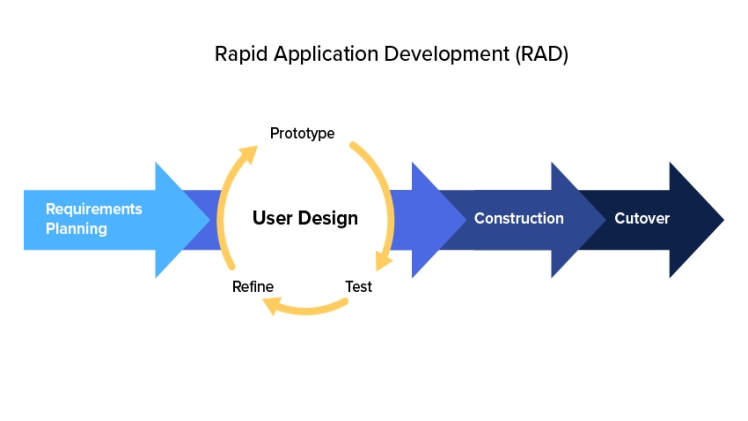
RAD has evolved throughout the years, but these four essential steps have remained the same over time.
The first step is to define your requirements.
As soon as rapid application development is introduced, it distinguishes itself from traditional methods of software development. Rather than asking for a complete list of specifications, it only asks for a general description. Specifications can be given at different stages of the development cycle since the needs are so broad.
That’s where the real work gets done. Instead of adhering to a tight set of specifications, developers produce prototypes as quickly as possible with a wide range of features and functions. These prototypes are subsequently displayed to the clients, who decide what they like and dislike about the product or services.
In most cases, prototypes are rapidly put together to show off particular aspects, but they are not appropriately polished. When the client and developer agree upon the finished product, it is developed.
Get feedback from others
What works and what doesn’t are discussed in this stage. Visuals and interfaces are also included in the feedback process.
As a result of this feedback, prototyping continues. As a result of these two phases, a final product is created that meets both developer’s and clients’ needs.
Finish the software
This is where the client and software developer work together to finish the software’s features, functionalities, aesthetics, and interface. Before delivering to the client, stability, usability, and maintainability are of critical importance.
Rapid Application Development: Advantages and Disadvantages (RAD)
As a result of these procedures, application development can be a good choice for all projects, but that’s not the case. Small teams and rapid projects benefit from RAD software.
